

Hey there! As a ball valves supplier, I often get asked about how to calculate the flow coefficient of a ball valve. It's a crucial aspect for anyone looking to ensure that the ball valve they're using is the right fit for their specific application. So, let's dive right in and break down this process step by step.
First off, what exactly is the flow coefficient (Cv) of a ball valve? Well, the flow coefficient is a measure of a valve's ability to pass fluid. It represents the number of U.S. gallons of water at 60°F that will flow through the valve per minute with a pressure drop of 1 psi across the valve. In simpler terms, it tells you how much fluid can go through the valve under certain conditions.
Understanding the Basics
Before we start calculating, it's important to understand a few key factors that affect the flow coefficient of a ball valve. These include the valve size, the type of ball valve (full port or standard port), the material of the valve, and the fluid properties such as viscosity and density.
- Valve Size: Generally, larger valves have higher flow coefficients because they have a larger opening for the fluid to pass through. For example, a 2 - inch ball valve will typically have a higher Cv than a 1 - inch ball valve.
- Full Port vs Standard Port: A full - port ball valve has an opening that is the same size as the pipe it is connected to. This results in less resistance to flow and a higher flow coefficient compared to a standard - port ball valve, which has a smaller opening.
- Valve Material: Different materials can affect the internal surface roughness of the valve. A smoother internal surface will cause less friction and allow for a higher flow rate, thus increasing the flow coefficient.
- Fluid Properties: Viscous fluids will flow more slowly through a valve compared to less viscous fluids. Also, denser fluids may require more energy to move through the valve, which can impact the flow coefficient.
The Calculation Process
There are a few different methods to calculate the flow coefficient of a ball valve. One of the most common ways is by using the following formula:
[C_{v}=\frac{Q}{\sqrt{\Delta P}}]
Where:

- (C_{v}) is the flow coefficient
- (Q) is the flow rate of the fluid in U.S. gallons per minute (GPM)
- (\Delta P) is the pressure drop across the valve in psi
Let's say you have a ball valve and you want to find its flow coefficient. You first need to measure the flow rate of the fluid passing through the valve and the pressure drop across it. You can use flow meters and pressure gauges to obtain these values.
For example, if you measure a flow rate ((Q)) of 50 GPM and a pressure drop ((\Delta P)) of 4 psi, you can calculate the flow coefficient as follows:
[C_{v}=\frac{50}{\sqrt{4}}=\frac{50}{2} = 25]
However, this is a simplified calculation. In real - world applications, there are other factors to consider. For instance, if the fluid is not water at 60°F, you need to make some adjustments to the formula.
When dealing with non - water fluids, you can use the following modified formula:
[C_{v}=\frac{Q}{\sqrt{\Delta P}\times\sqrt{\frac{\rho}{\rho_{w}}}}]
Where:
- (\rho) is the density of the fluid
- (\rho_{w}) is the density of water at 60°F (approximately 62.4 lb/ft³)
Manufacturer's Data and Testing
While the above formulas give you a way to calculate the flow coefficient, it's important to note that most ball valve manufacturers provide flow coefficient data for their products. They conduct extensive testing in their laboratories to determine the Cv values under different conditions.
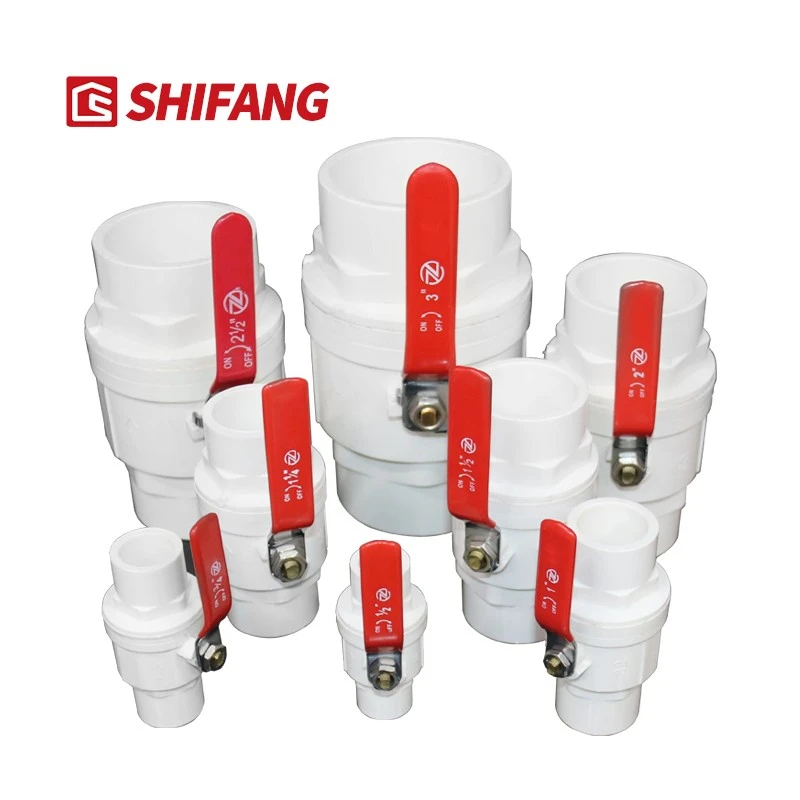
When you're selecting a ball valve for your application, it's a good idea to refer to the manufacturer's catalog. This will give you an accurate Cv value for the specific valve model you're interested in. For example, if you're looking for a PVC Steel Handle Ball Valve, the manufacturer's data will tell you its flow coefficient based on various factors like valve size and port type.
In addition to using manufacturer's data, you can also perform your own testing. This is especially useful if you have unique operating conditions or if you want to verify the manufacturer's claims. You can set up a test rig with a ball valve, a flow meter, and pressure gauges to measure the flow rate and pressure drop. Then, use the formulas mentioned above to calculate the flow coefficient.
Importance of Accurate Flow Coefficient Calculation
Calculating the flow coefficient accurately is crucial for several reasons.
- System Performance: If you choose a ball valve with a flow coefficient that is too low for your application, it can cause excessive pressure drops in the system. This can lead to reduced flow rates, increased energy consumption, and even damage to other components in the system. On the other hand, if the flow coefficient is too high, it may result in over - sizing the valve, which can be costly.
- Safety: In some applications, such as in chemical processing or water treatment plants, accurate flow control is essential for safety. An incorrect flow coefficient can lead to improper mixing of chemicals or inaccurate dosing, which can have serious consequences.
Different Types of Ball Valves and Their Flow Coefficients
We offer a variety of ball valves, each with its own characteristics and flow coefficients.
- PVC Flap Foot Valve: These valves are often used in pumping systems to prevent backflow. They have a specific flow coefficient that is determined by their design and size. The flap design allows for a relatively smooth flow in the forward direction but restricts flow in the reverse direction.
- PVC Socket Thread Ball Valves: These valves are easy to install and are commonly used in plumbing applications. Their flow coefficients can vary depending on the size of the valve and whether it is a full - port or standard - port design.
Conclusion
Calculating the flow coefficient of a ball valve is an important step in ensuring the proper operation of your fluid system. Whether you use the formulas, rely on manufacturer's data, or conduct your own testing, getting an accurate Cv value will help you select the right ball valve for your needs.
If you're in the market for high - quality ball valves and need more information about flow coefficients or any other aspect of our products, don't hesitate to reach out. We're here to help you make the best choice for your application. Contact us to start a procurement discussion and find the perfect ball valve for your project.
References
- Crane Technical Paper No. 410, "Flow of Fluids Through Valves, Fittings, and Pipe"
- Perry's Chemical Engineers' Handbook